
The Reality of Restorative Reproductive Medicine

The Reality of Restorative Reproductive Medicine
What is RRM?
Restorative Reproductive Medicine
Restorative Reproductive Medicine (RRM) has gained attention as some conservative advocacy groups promote it as an alternative to IVF. However, RRM and IVF are not interchangeable treatments. RRM is practiced by a subset of clinicians, whom follow belief-based ethical frameworks that limit certain fertility treatments. Patients deserve complete, evidence-based information about all available options so they can make informed decisions about their care.
Is RRM a new
breakthrough?
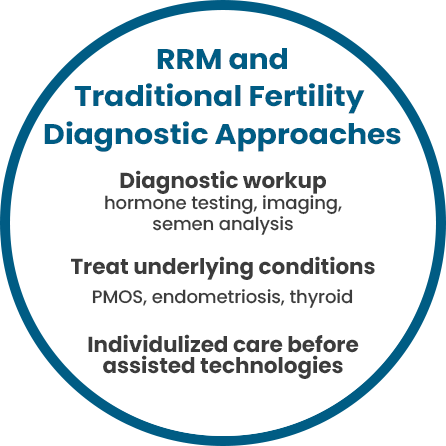
No. RRM has existed in various forms for decades. Many of its diagnostic approaches are already part of routine fertility care in traditional fertility clinics. In fact, the initial evaluation and diagnostic process is often largely the same.
Is a doctor practicing RRM a real doctor?
Yes. RRM practitioners are licensed medical professionals.
However, they have taken an oath to abide by the International Institute for Restorative Reproductive Medicine code of ethics, which restricts certain fertility treatments, including IVF and IUI.
As a result, an RRM practitioner do not offer IVF or IUI treatments even when they would otherwise be medically appropriate options for a patient.
IS RRM completely different fertility care?
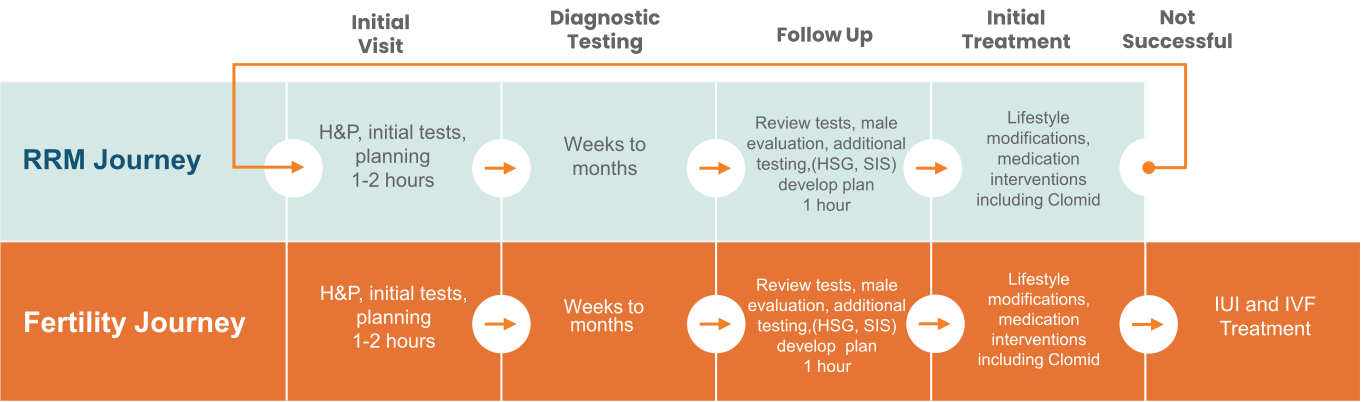
No and Yes. The initial evaluation and diagnostic steps are similar to those used in traditional fertility care.
But, the key difference comes after diagnosis. RRM practitioners limit certain treatment options based on their ethical framework—not because those treatments lack medical evidence.
As a result, patients may not be offered the full range of evidence-based fertility treatments available through traditional fertility care such as IVF.
Typical types of early testing regardless of practitioner – RRM or Traditional Fertility:
RRM does not allow:
Do RRM doctors and fertility specialists
provide the same care?
No. Both providers may begin with similar evaluations.
The difference often comes after diagnosis.
RRM does not offer complete access to all technologies for fertility patients, based on a groups ethical beliefs vs. evidence-based medical understanding.
A reproductive endocrinologist can offer the full spectrum of fertility treatments, while an RRM provider follow practice guidelines that limit certain treatment options, based on their ethical code not medical diagnosis.
Does RRM allow for every fertility option?
No. International Institute for Restorative Medicine, the credentialing body for RRM, prohibits via their code of ethics referring for IUI or IVF. This will limit treatment options for patients.
Patients should know all available options.
It’s natural to want to have a child and families should have every option to help them succeed